


Vanlaxmi
Vanlaxmi
Couldn't load pickup availability
Vanlaxmi is one of the most quietly promising commercial mangoes to emerge from Gujarat — a variety that carries every credential of a winner on paper, yet still waits for the wider reputation she deserves. Slowly but steadily, she is gaining ground among Indian mango growers who recognise her commercial potential.
Her story begins in the early 1980s at Patel Farm and Nursery in Valsad, Gujarat, owned by Shri Thakorbhai Ambalal Patel. A natural cross-pollination occurred between two prized parents standing side by side on his land — Vanraj, famed for its attractive colour and long shelf life, and Jamadar, equally celebrated for its taste and flavour. In 1981-82, Thakorbhai harvested five unusual mangoes from the Vanraj tree, sowed the stones, and six to seven years later one seedling fruited with a striking red-peeled fruit of impressive taste and keeping quality. Shri Mohanlal Dayalji Patel, a progressive Gujarati farmer, recognised its potential and began multiplying it. In 1995, the variety was named Vanlaxmi — "Van" from its parent Vanraj, and "Laxmi" from Mohanlal's mother, Laxmiben Patel.
The fruit is genuinely beautiful — a blend of red, yellow and green, with most of the peel covered in a deep red blush and finished with a generous natural wax that boosts both shelf appeal and storage life. Each mango averages 250–300 grams, oval-oblong in shape with a prominent beak. Inside, the pulp is orange-yellow, juicy, completely fibreless, and firm enough to hold its body even when the peel begins to wrinkle. The flavour is tropical with subtle hints of spice, and the taste carries a generous sweetness at TSS up to 21° Brix balanced by a pleasing sugar-acid blend — making her an excellent table mango. Fruits ripen in June, placing her in the mid-season window.
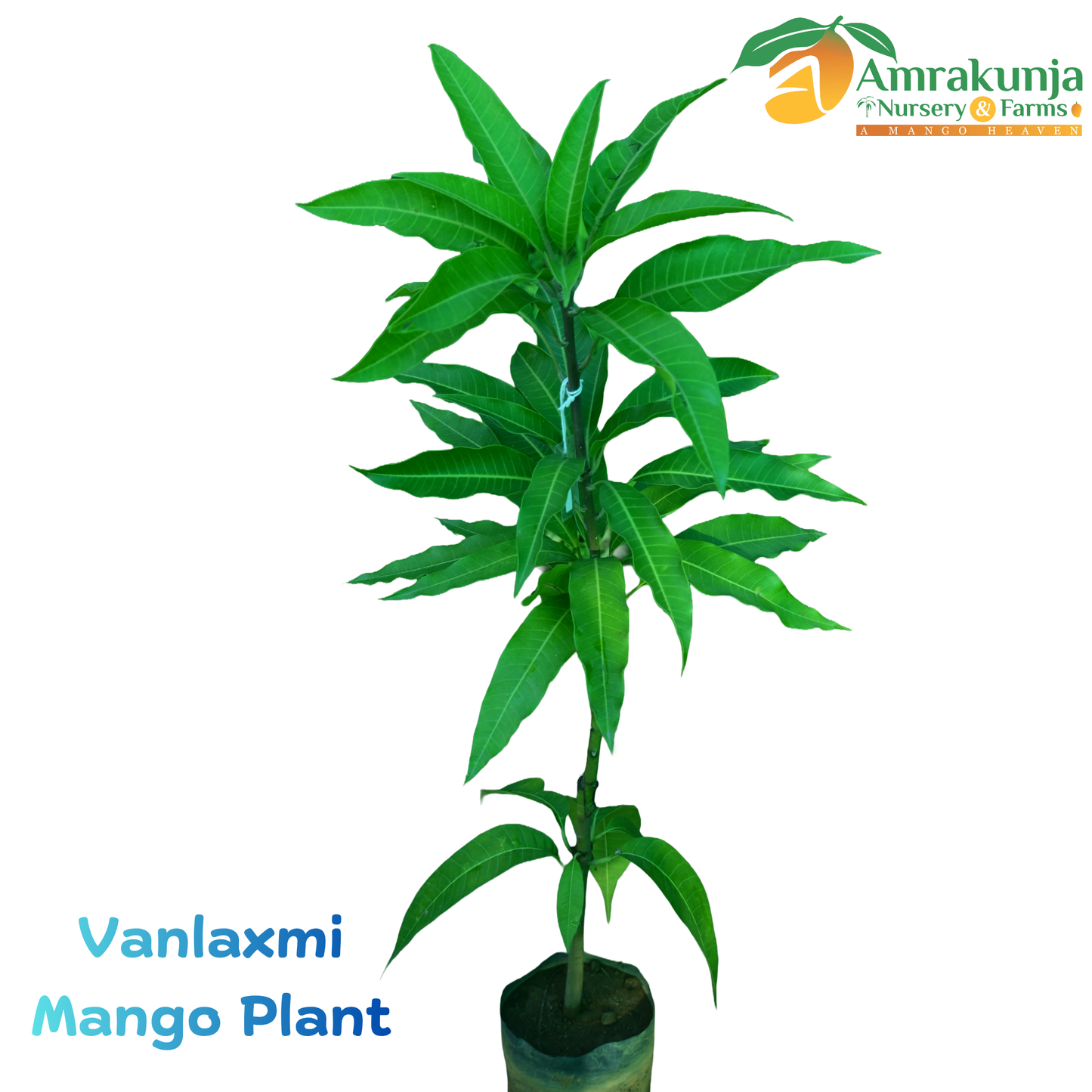
On the tree side, Vanlaxmi is a regular and heavy bearer. The trees grow to moderate height with an open canopy, making her naturally suited to high-density planting. The seeds are monoembryonic, so she can only be propagated by grafting; however, the stone is small at just 16% of fruit weight, giving an exceptionally high pulp recovery of about 70%. She is almost disease-free, free of spongy tissue, and offers a shelf life of 10–12 days — an ideal window for organised retail and distant markets.
Colour, taste, flavour, shelf life, heavy regular bearing, compact tree, disease resistance, high pulp recovery — Vanlaxmi has every trait a commercial grower asks for, making her an excellent choice from the angle of commercial feasibility. Despite this, lack of awareness has held her back, and limited export attempts have been overshadowed by Kesar and Sonpari in Gujarat. What she truly needs is wider publicity among mango farmers — for in Vanlaxmi lies a variety genuinely worth planting, promoting, and tasting.
ColourAttractive redAverage Weight300 gramsSweetnessTSS up to 21 BrixPulp Recovery70%Shelf Life10-12 daysSeed TypeMonoembryonicBearingRegular and heavy bearer
Share

Origin & Identity
- OriginGujarat, India
- Variety TypeSeasonal; bears once in a year
- Categorymid-season
Fruit Profile
- Fruit ColourAttractive red
- AromaYes, present
- Flavour ProfileIndian
- Taste & SweetnessAdequately sweet (TSS: up to 21 brix)
- Avg. Fruit Weight300 grams
- Pulp Recovery70%
- Stone / Seed TypeMonoembryonic
Plant & Growing
- Growth PatternModerate
- Bearing HabitRegular and heavy bearer
- Harvesting SeasonIn the month of June
- Fruit Shelf LifeHigh: 10-12 days
Suitability
- Best Suited ForTable purpose
- Commercial FeasibilityYes, Highly Recommended