


Sweet Tart
Sweet Tart
Couldn't load pickup availability
Sweet Tart mango, a flavour bomb, traces back to the renowned breeding programme of Gary Zill in Boynton Beach, Florida, USA, where the original tree was catalogued under the selection number C-1. It arose as a seedling of Zill Indochinese — affectionately known among growers as Zinc — which places Sweet Tart firmly within the celebrated Indochinese-flavoured branch of the Florida mango world.
The Sweet Tart mangoes are small to medium in size, oval to oval-oblong in shape, typically weighing somewhere between roughly 300 and 350 grams and often surprisingly heavy for their size.
At maturity the skin turns a clean, sunny yellow, sometimes carrying a light red blush or a scatter of harmless speckles across the shoulders. Cut one open, and it releases the perfumed, floral aroma.
The pulp is a deep, vivid orange — medium-firm, entirely fibreless and juicy — deepening in colour as the fruit ripens. But it is the flavour that has won Sweet Tart its devoted following. It eats like a genuine "flavour bomb": an intense, complex richness built around a big, sour-candy tang that is met, blow for blow, by an equally big punch of sweetness, all lifted by a subtle citrus undertone. Enjoyed slightly under-ripe, the tartness is at its most electric and truly awakens the palate; left to ripen fully, that same tartness softens and the sweetness turns almost cola-syrup-like and syrupy-smooth. Sweet Tart can be enjoyed at several different stages of ripeness — it consistently ranks as a Top 5 mangos among those who love real tang, though palates that prefer a milder, sweeter fruit sometimes find it too assertive.
Sweet Tart is a mid-to-late season mango, ripening in West Bengal (India) in the first/second week of July; and in Florida (USA) through July and into August. It carries its crop in clusters on individual panicles, and fruit size on the tree is largely governed by how many fruits a panicle is allowed to hold — thinning heavy clusters rewards the grower with noticeably larger mangoes. The fruit does not ripen well if picked too green, so it is best left on the tree until the skin just begins to colour and blush.
The seed is polyembryonic. Even so, grafted trees remain the preferred choice, coming into bearing sooner and fruiting more uniformly. It is worth noting that the flesh-to-seed ratio is on the modest side — the seed is generous relative to the fruit.
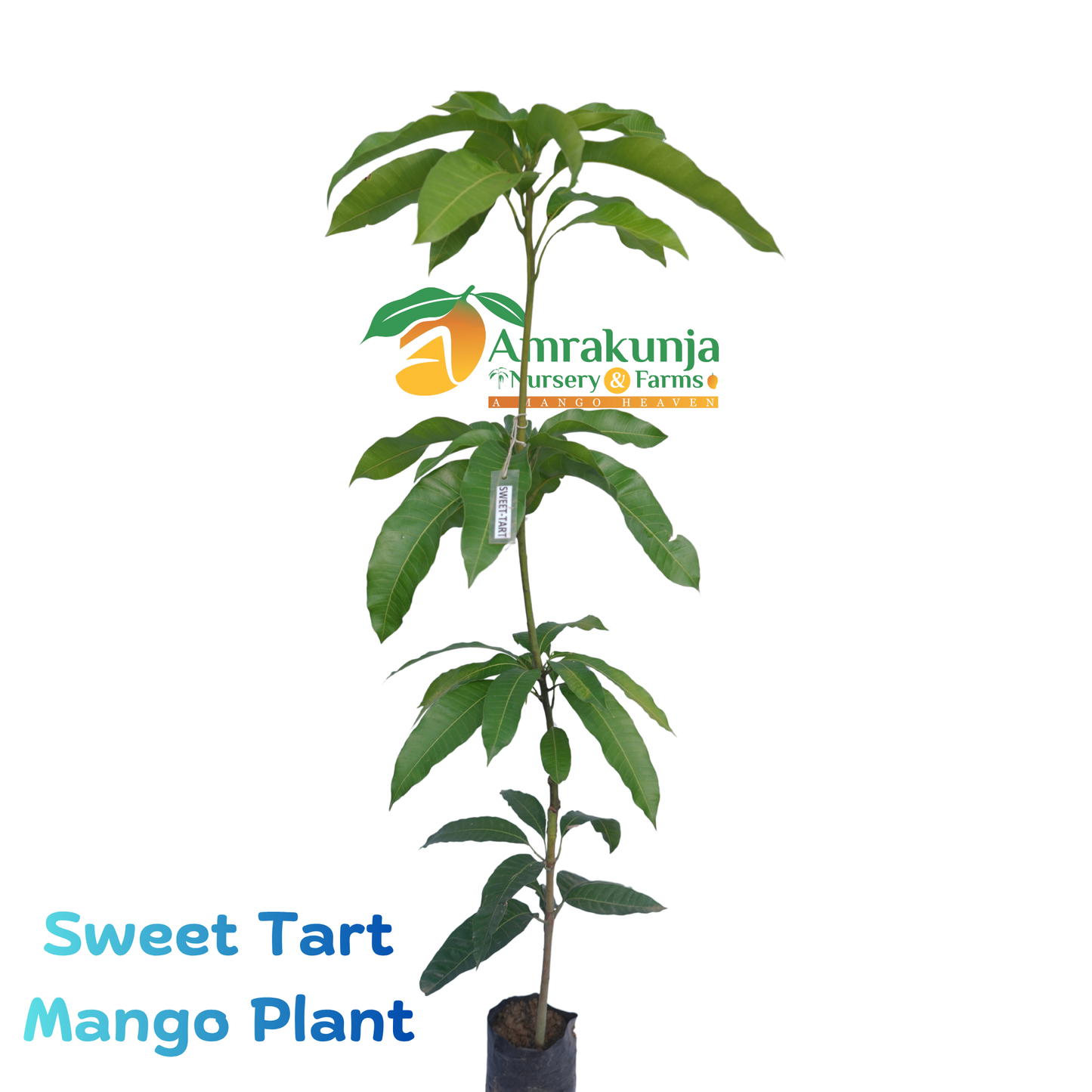
The tree is medium to large, with a moderately vigorous, upright, somewhat vertical habit and a fairly compact, well-branched canopy that supports good productivity. It responds well to annual pruning and can be comfortably held in the region of 10–20 feet (roughly 3–6 metres) in a home landscape — making it a fine choice for a kitchen garden, a rooftop garden, a small orchard, or a larger farm planting. The commercial aspect of this mango would be judged by its performance over the next few years under Indian soil and climatic conditions.
ColourGreen with a clean, sunny yellow on the sides, sometimes carrying a light red blushAverage Weight300-350 gramsSweetnessTSS upto 22 BrixShelf LifeModerate — approximately 1 weekSeed TypePolyembryonicBearingRegular and very heavy bearer in India — bears in bunches
Share

Origin & Identity
- OriginFlorida
- Variety TypeSeasonal
- Categorymid to late season
Fruit Profile
- Fruit Colourgreen with a mix of yellow; sometimes with a red blush
- AromaAromatic like Indian mangoes
- Flavour ProfileComplex, it's a flavour bomb
- Taste & SweetnessComplex, a combination of sweetness and tartness
- Avg. Fruit Weight300-350 grams
- Pulp RecoveryAround 65%
- Stone / Seed TypePolyembryonic
Plant & Growing
- Growth PatternModerately vigourous; can be maintained under a certain height if pruned regularly
- Bearing HabitRegular and heavy bearer
- Harvesting SeasonFirst or second week of July in West Bengal in India; July-August in Florida in USA
- Fruit Shelf Lifemoderate, one week
Suitability
- Best Suited ForTable purpose
- Commercial FeasibilityUnder observation