


Palmar / Palmer
Palmar / Palmer
Couldn't load pickup availability
A large yet beautiful, late-season Florida mango, Palmar / Palmer is one of the most widely exported cultivars — the purple-blushed fruit that fills European supermarkets through the Brazilian season.
The original Palmar tree grew from a seed planted around 1925 on the property of Mrs. Victor Mell in Miami. Its parentage was unknown for decades until a 2005 pedigree analysis identified it as a seedling of Haden. It was first propagated in 1945 and formally named in 1949, and has since been planted commercially in Brazil, Puerto Rico, Australia and West Africa.
The fruit is large and distinctly elongated — ovate-oblong, drawn out at both the stem and stylar ends — typically 1–2 lbs (450–900 g), with exceptional specimens running heavier. Its most striking feature is colour: a deep purple-crimson blush laid over a yellow base, giving ripe fruit the look of a bruised sunset. The flesh is orange-yellow with little fibre, smooth and firm-textured, with a weak aroma and a mild, sweet flavour of good quality — unassertive rather than complex, which makes it a reliable crowd-pleaser and an excellent fruit for juices, smoothies and desserts. The seed is monoembryonic and relatively thin.
It is a late midseason to late-season cultivar, ripening July to early September in Florida, USA (in July-August in West Bengal, India). One important caveat noted by growers and the trade: Palmer colours up early, and the blush is not a reliable indicator of maturity, so fruit is frequently picked immature, which blunts its flavour. Judge ripeness by feel and shoulder fill, not by colour.
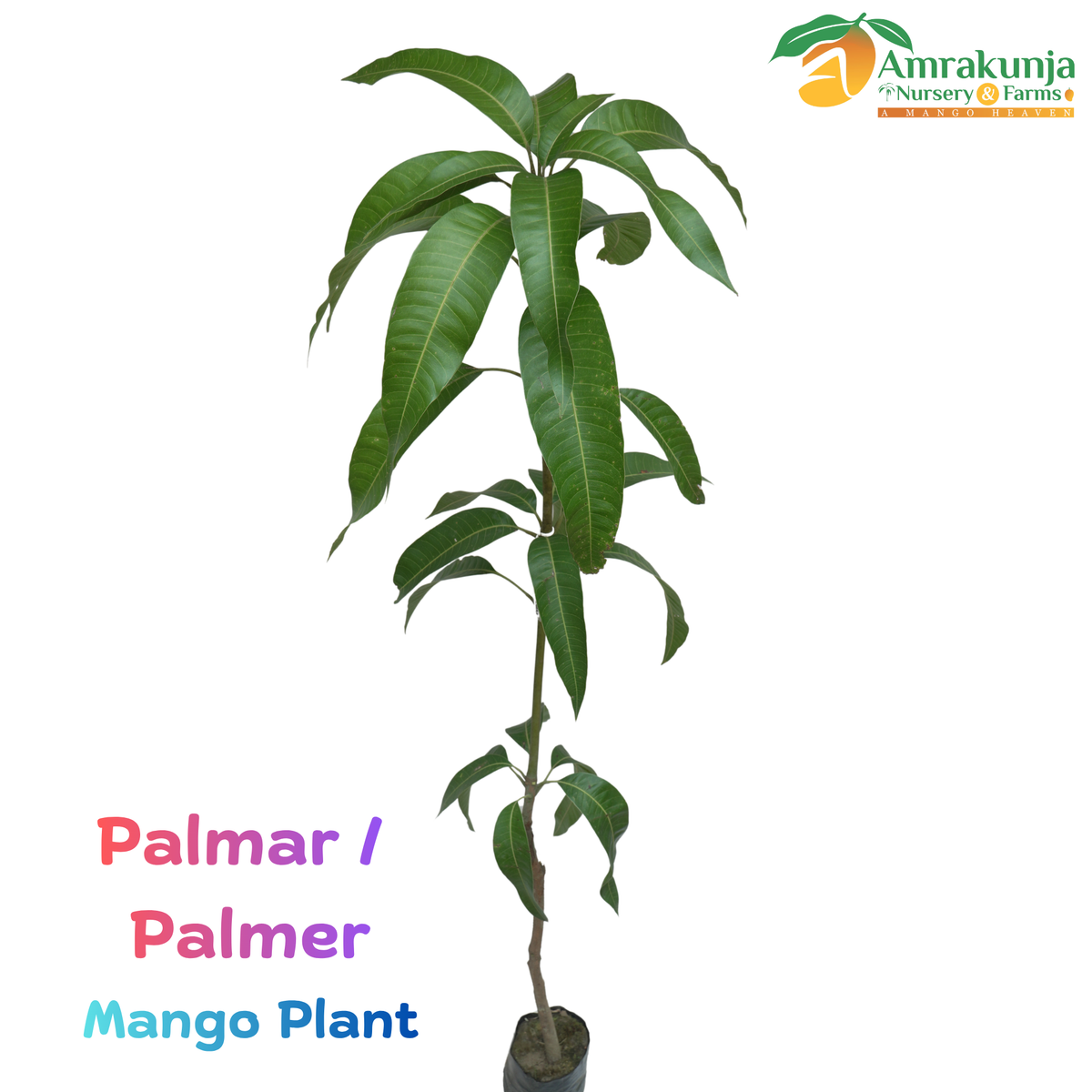
The tree is moderately vigorous with a distinctly upright canopy and bears consistently. However, it can be kept dwarf and semi-dwarf through regular annual pruning, making it a workable choice for smaller gardens and containers.
ColourBright redAverage Weight600 gramsSweetnessTSS upto 19 BrixShelf LifeGood — approximately 2 weeksSeed TypeMonoembryonicBearingRegular and heavy bearer
Share

Origin & Identity
- OriginFlorida, USA
- Variety TypeLate-season
- CategorySeasonal
Fruit Profile
- Fruit ColourBright red
- AromaAverage
- Flavour ProfileAverage
- Taste & SweetnessGood
- Avg. Fruit Weight600 grams
- Pulp Recovery70%
- Stone / Seed TypeMonoembryonic
Plant & Growing
- Growth PatternVigorous
- Bearing HabitRegular and heavy
- Harvesting SeasonJuly-August
- Fruit Shelf LifeGood
Suitability
- Best Suited ForJuice, Table purpose
- Commercial FeasibilityYes