


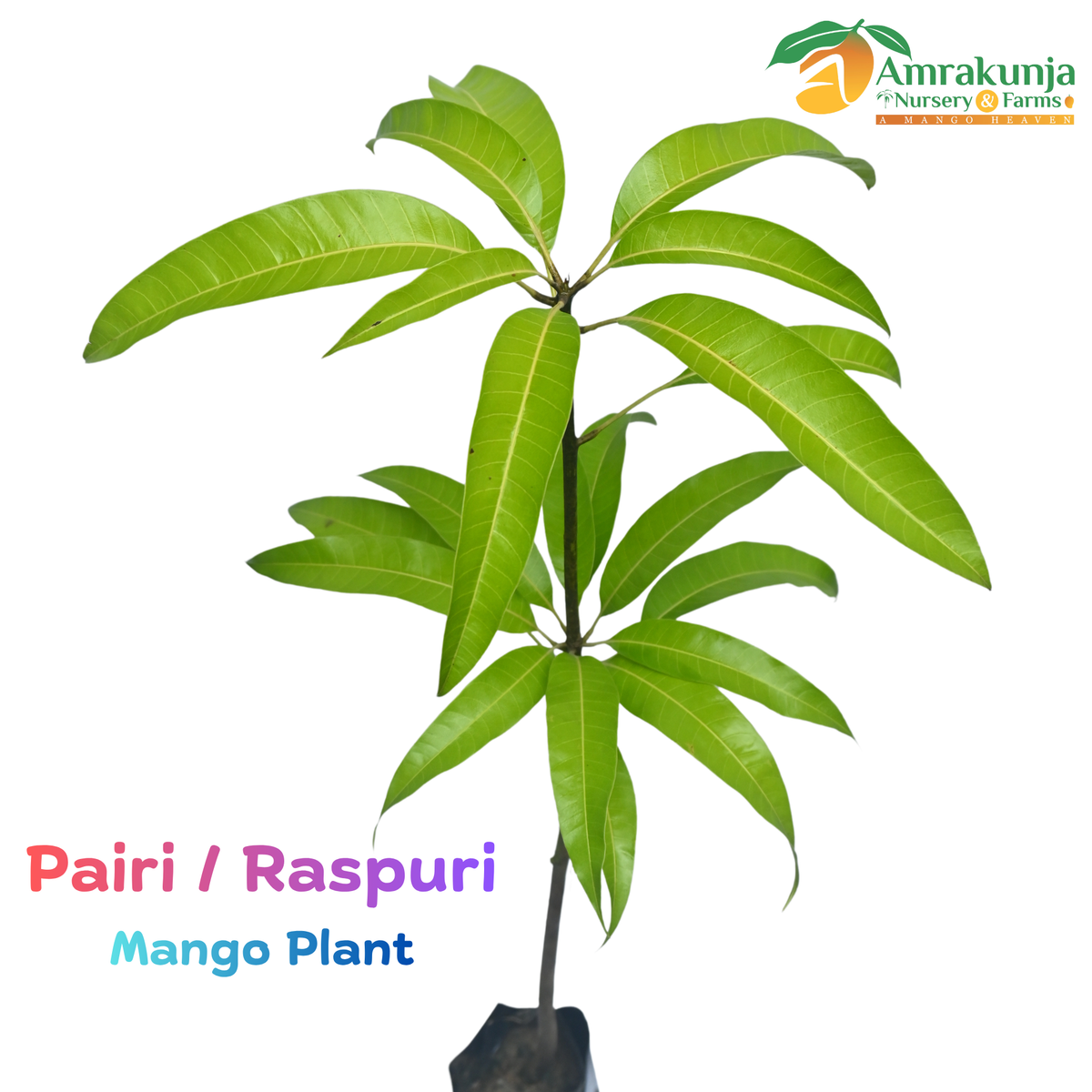
Pairi / Raspuri
Pairi / Raspuri
Couldn't load pickup availability
Widely regarded as regional names for the same cultivar, Pairi (also spelled Payri, Payari or Paheri) is how this mango is known across Konkan coast (primarily in Maharashtra) in India — e.g. Ratnagiri, Raigad, Devgad and Pawas — while it is called Raspuriin Karnataka, where it dominates orchards in and around Bengaluru, Ramanagara, Kolar, Chikkaballapura and Tumakuru, the historic Old Mysuru belt. The name is traced to the Sanskrit rasa, meaning juice, a direct nod to the fruit's defining quality. In Maharashtra it is affectionately called Amrut Payari (amrut = nectar), standing second only to Alphonso in regional esteem.
The fruit is oval and slightly tapered, small to medium at roughly 150–250 grams, finishing in a small pointed non-stem end — the distinctive "nose" Konkan growers use to identify it. The peel is thin, smooth and taut, showing variegated yellow-green shades with fine dark brown-black speckling; sun-exposed fruit develops a red-orange blush, and Karnataka-grown Raspuri typically ripens to reddish-yellow. Certain Maharashtra strains, locally called Suraj Mukhi, carry a pronounced reddish tinge. A practical quirk worth knowing: Raspuri ripens from the inside out, so skin colour is an unreliable maturity guide — the fruit may still look green while fully ripe, and softness of flesh is the true indicator.
The pulp is golden-orange, dense yet aqueous, soft, tender and lightly fibrous, enclosing a thin, flat monoembryonic seed.
The flavour is sweet with a subtle tartness and a distinctly floral, fruity character — tasting notes consistently cite honey, peach and apricot, with a gentle spice note in Konkan fruit. The ripe fruit releases a pronounced sweet (TSS upto 20 brix), floral fragrance. Pairi is well-known for its outstanding sugar-acid blend.
Nutritionally it is a strong carotenoid source; a study by Veda, Platel and Srinivasan (ICAR-CFTRI, Mysuru) found Raspuri had the highest β-carotene bioaccessibility (39.1%) among six Indian cultivars tested, outperforming Badami, Mallika, Malgoa, Totapuri and Neelam — meaning a greater share of its provitamin A is actually absorbed by the body. The same work found that blending mango with milk — exactly how Raspuri is traditionally consumed as lassi or milkshake — raises β-carotene bioaccessibility further by 12–56%.
It is among the earliest mangoes of the season, arriving before Alphonso; the Karnataka harvest runs April–June with market availability through end-June, and Konkan Pairi typically lands from mid-May.
Pairi is a vigorous, large-canopied tree rather than a compact one. However, through annual pruning, the height can be managed under desired length.
Culinarily it is the aamras mango par excellence. Its juicy, low-fibre pulp is blended with Alphonso to produce the classic Maharashtrian and Gujarati aamras, and it converts readily into juices, nectars, jams, fruit cheese, shrikhand, ice cream and yoghurt, as well as bakery fillings and infant fruit foods - it is one of the industry favourites. Production-wise, Pairi has on-season (bears heavily) and off-season (bears less) in alternate years.
Ripe Pairi is traditionally eaten by softening the fruit between the palms and sucking the pulp through a small tear at the top.
ColourYellow-green shades with orange-red blushAverage Weight150-250 gramsSweetnessTSS upto 20 BrixShelf LifeGood - 8 daysSeed TypeMonoembryonic, small and thin BearingAlternate - On-year (heavy) and Off-year (less)
Share

Origin & Identity
- OriginKonkon Coast, India
- Variety TypeSeasonal
- CategoryEarly season
Fruit Profile
- Fruit ColourYellow-green shades with orange-red blush
- AromaHigh
- Flavour ProfileGood sugar-acid blend
- Taste & SweetnessVery tropical, good sugar-acid blend
- Avg. Fruit Weight150-250 grams
- Pulp Recoverymore than 80%
- Stone / Seed TypeMonoembryonic, small and thin
Plant & Growing
- Growth PatternVigorous
- Bearing HabitAlternate
- Harvesting SeasonEarly season
- Fruit Shelf LifeGood - 8 days
Suitability
- Best Suited ForSucking and food processing industry
- Commercial FeasibilityYes