


Alphonso / Hapus
Alphonso / Hapus
Couldn't load pickup availability
Alphonso (Hapus)
Known in Marathi as Hapus, the Alphonso is India’s most celebrated mango and the benchmark against which the country’s other cultivars are judged - it is known for its heavenly aroma, taste and flavour for the last five centuries. Its home is the Konkan coast of Maharashtra,India and fruit from Ratnagiri is among the most prized of all.
The variety is named after Afonso de Albuquerque, the Portuguese general who established a colony in Goa in the early 1500s. The Portuguese introduced grafting to Indian mango growing, and the Alphonso emerged from that work before spreading along the western coast and settling into the Konkan.
The fruit is medium-sized and ovate-oblique, typically 200-300 grams. When fully ripe the peel turns a bright golden-yellow, often with a red tinge across the top. The pulp is saffron-coloured, rich, creamy and fibreless, with abundant juice. Its signature aroma has a clear scientific basis: Alphonso is unusually rich in lactones and furanones, and a comparative study of 27 Indian cultivars found it carried the highest diversity of aroma volatiles of any variety tested. Sweetness is high, at around 20 °Brix and above. At the Amrakunja Nursery & Farms in West Bengal, India, Alphonso mango trees sourced from Ratnagiri, Maharashtra, produced fruit with a total soluble solids (TSS) level of 23 °Brix, along with grand Alphonso taste and flavour. Alphonso seeds are monoembryonic, and hence can be propagated only through grafting.
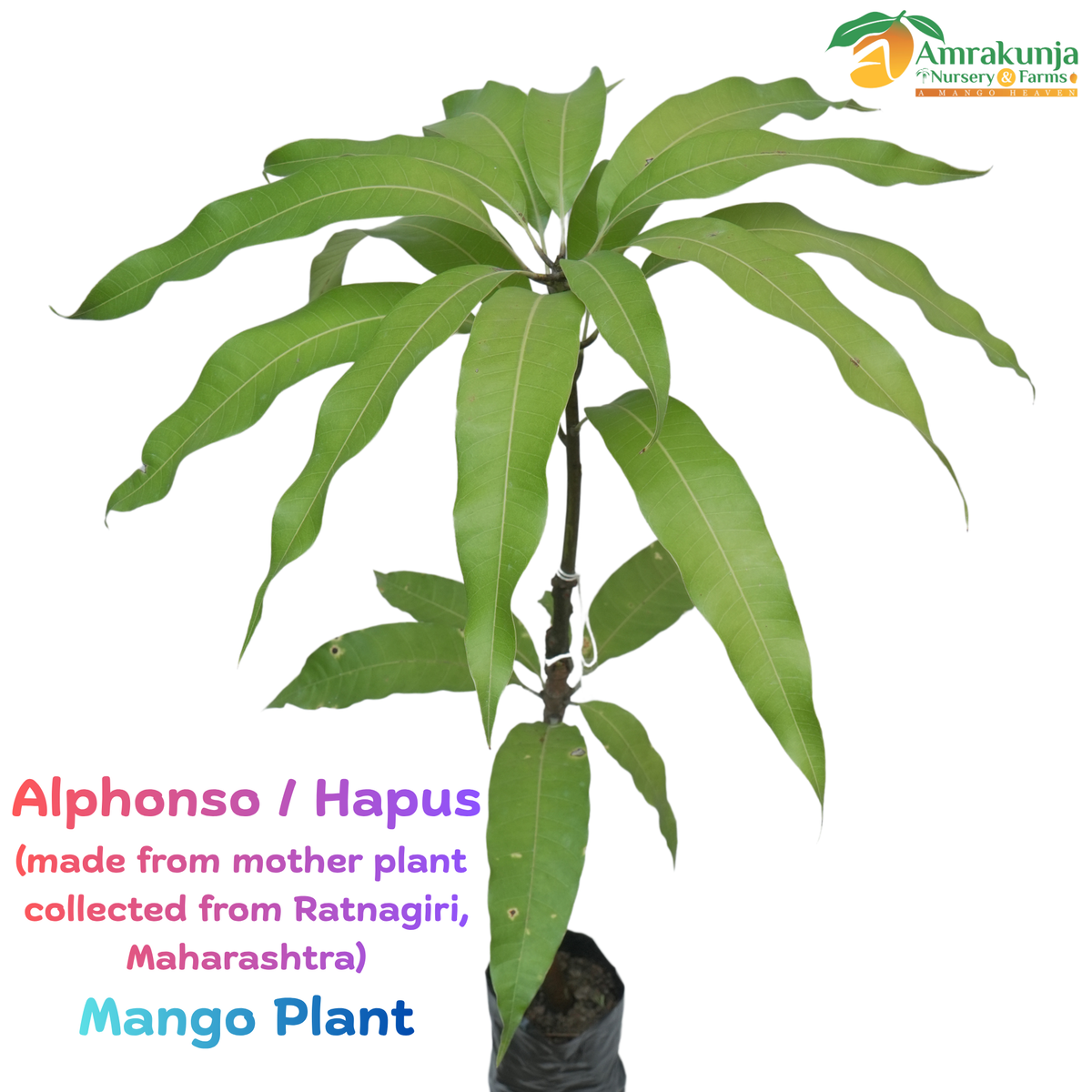
Based on the experience gained at Amrakunja Nursery & Farms in West Bengal, the specific Alphonso mango strain sourced from Ratnagiri, Maharashtra, could perform almost on par with the original alphonso of Ratnagiri in production, aroma, taste, and flavour, in the soil and climate of West Bengal.
Alphonso is also distinguished by its keeping quality - 12 to 15 days which explains why it travels so well and has long dominated Indian mango exports. It is excellent for pulping and canning as well as fresh eating, and is the classic fruit for making ice creams, aamras, shrikhand and kulfi. The season runs from mid-March to the end of May in Maharashtra, India. At Amrakunja Nursery & Farms in West Bengal, India, Alphonso/ Hapus ripens in the 2nd/3rd week of May.
The variety has one serious weakness: spongy tissue, an internal disorder that leaves patches of flesh soft, corky and sour. It can affect up to 30% of fruit in a single batch and is a major cause of export rejections. Alphonso is also demanding to grow, needing close attention to grafting, pruning and orchard care.
In October 2018, Alphonso from the five Konkan districts of Ratnagiri, Sindhudurg, Raigad, Thane and Palghar received Geographical Indication protection, reserving the name for fruit from this region.
Though Alphonso trees are vigorous and spreading in nature, the trees can be maintained dwarf by yearly pruning after harvest.
ColourGolden-yellow, with a red tinge across the topAverage Weight250 gramsSweetnessTSS upto 23 BrixShelf LifeHigh, 12-15 daysSeed TypeMonoembryonicBearingHas on-year and off-year bearing
Share

Origin & Identity
- OriginRatnagiri, Maharashtra, India
- Variety TypeMid-season
- CategorySeasonal
Fruit Profile
- Fruit ColourYellow-orange
- AromaEnchanting
- Flavour ProfileExcellent
- Taste & SweetnessExceptional
- Avg. Fruit Weight250 grams
- Pulp Recoverygood
- Stone / Seed TypeMonoembryonic
Plant & Growing
- Growth PatternVigorous, spreading canopy
- Bearing HabitHas off-year and on-year
- Harvesting SeasonMay in West Bengal, India
- Fruit Shelf LifeHigh 12-15 days
Suitability
- Best Suited ForTable purpose, making ice creams, juices, pulps etc.
- Commercial FeasibilityYes